Oxygenation in aquaculture is the supply and control of dissolved oxygen in farm water to keep it within the range fish need. It’s critical because it determines metabolism, growth, and survival: below certain thresholds, oxygen stops being a parameter and becomes the limit on how many kilos a site can produce. In salmon farming, keeping dissolved oxygen above 5–6 mg/L and avoiding hypoxia is the foundation of operational continuity.
At CPI Equipment we’ve spent more than 30 years solving this at farm sites. This guide explains what it is, how it’s measured, and what methods exist — with data, not promises.
Why Does Dissolved Oxygen Matter at a Farm Site?
Dissolved oxygen (DO) is the oxygen present in water, expressed in mg/L or as a percentage of saturation. Fish breathe it through their gills, and demand rises with temperature, biomass, and post-feeding digestion. When DO drops, the effect is immediate and measurable:
- Above 6 mg/L: optimal condition, normal growth.
- Between 4 and 5 mg/L: stress, lower feed intake, worse feed conversion (FCR).
- Below ~60% saturation (hypoxia): mortality, gill damage, higher vulnerability to pathogens.
It’s not just about avoiding deaths: every unnoticed DO drop costs kilos never harvested.
Aeration vs. Oxygenation: Which to Use and When
They’re different things, and they’re often confused.
| Aeration | Oxygenation | |
|---|---|---|
| What it injects | Ambient air | Pure oxygen |
| How it raises DO | Moves water, passive exchange | Direct, metered injection |
| Extra benefit | Stabilizes temperature, disperses blooms, mitigates Caligus | Corrects DO with precision during critical events |
| When | Stratification, upwelling, prevention | High biomass, low-DO events |
In practice, they don’t compete: they complement each other. Aeration organizes the water column; oxygenation corrects DO when ambient conditions fall short.
Oxygenation Methods in Aquaculture
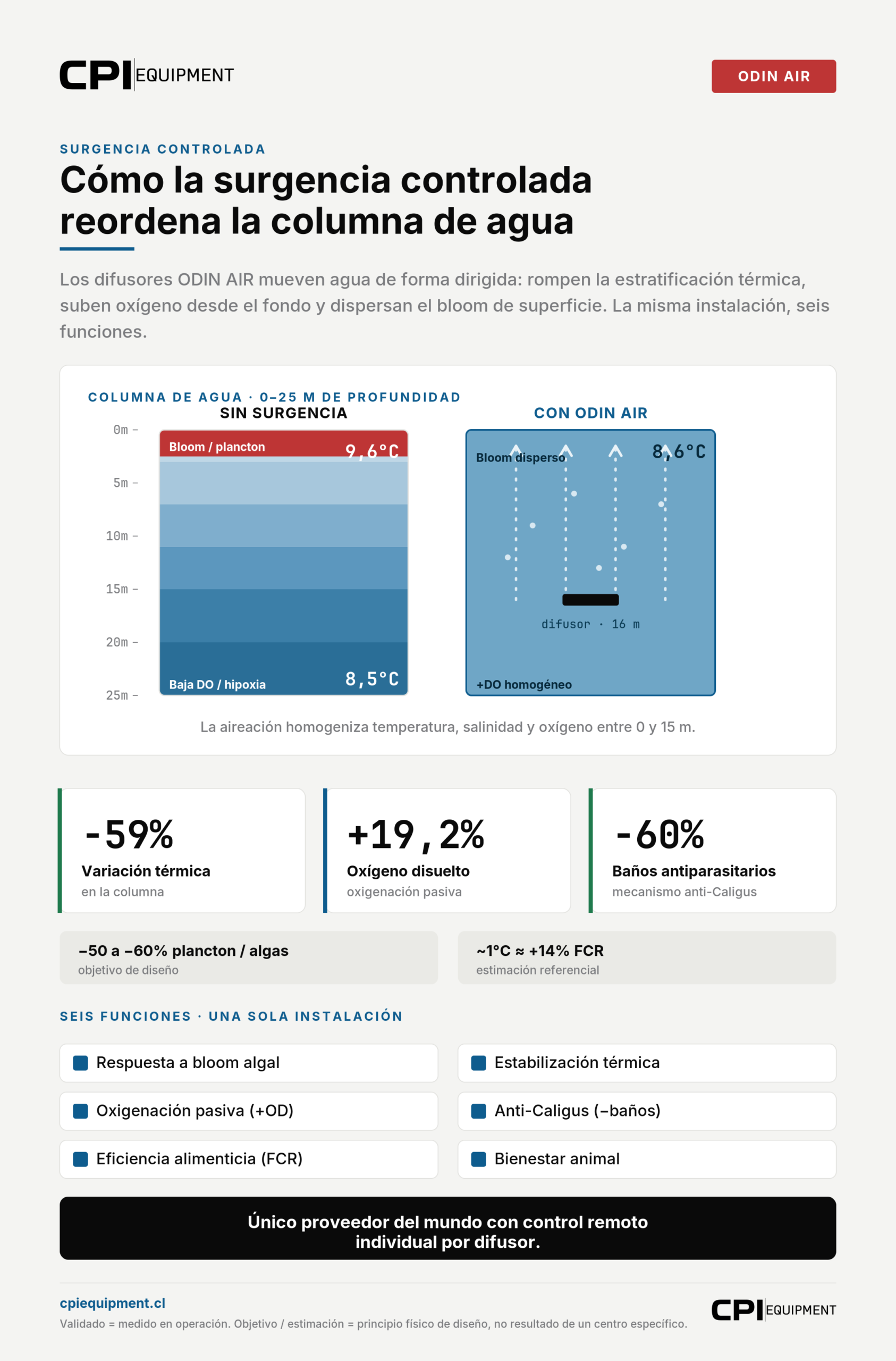
1. Aeration with Blowers and Diffusers. Injects compressed air through diffusers. Raises DO passively and, above all, moves water to break up stratification.
2. Pure Oxygen Injection. For intensive, high-biomass systems. Uses liquid oxygen or on-site generated oxygen to reach saturations that air can’t achieve. The key is how it’s injected: by real mass, not apparent volume.
3. Nanobubbles. Ultra-fine bubbles that stay suspended far longer, maximizing oxygen transfer and reducing gas waste. CPI applies this technology both in farming and in seabed remediation.
What Determines Dissolved Oxygen
A site’s DO isn’t a fixed number; it rises and falls with several factors:
- Temperature: as water temperature in salmon farming rises, dissolved oxygen retention drops and fish metabolism speeds up.
- Salinity: the higher the salinity, the lower the water’s oxygen-holding capacity.
- Biomass and feeding: more fish and digestion drive up consumption.
- Thermal stratification: the water column separates into layers; the bottom stays cold and oxygen-poor.
- Photosynthesis (day/night and season): at night and in winter there’s no oxygen production, which is why DO drops in the early morning and during low-light months.
Of these, stratification is the one that can be intervened on most — and that’s where controlled upwelling comes in.
How Dissolved Oxygen Is Measured and Controlled
It’s measured with DO sensors in mg/L and % saturation, ideally at different depths and in real time. But measuring isn’t controlling: the real leap is dosing with precision.
And here’s the point that changes everything: oxygen must be measured and delivered by real mass (NL/min), not apparent volume. The volume a pressurized rotameter reads overstates what the fish actually receives. That’s why “400 isn’t 400”: 400 rotameter units at high pressure don’t equal 400 units of oxygen mass. Measuring by mass makes dosing traceable 1:1 with consumption.
The Role of Controlled Upwelling
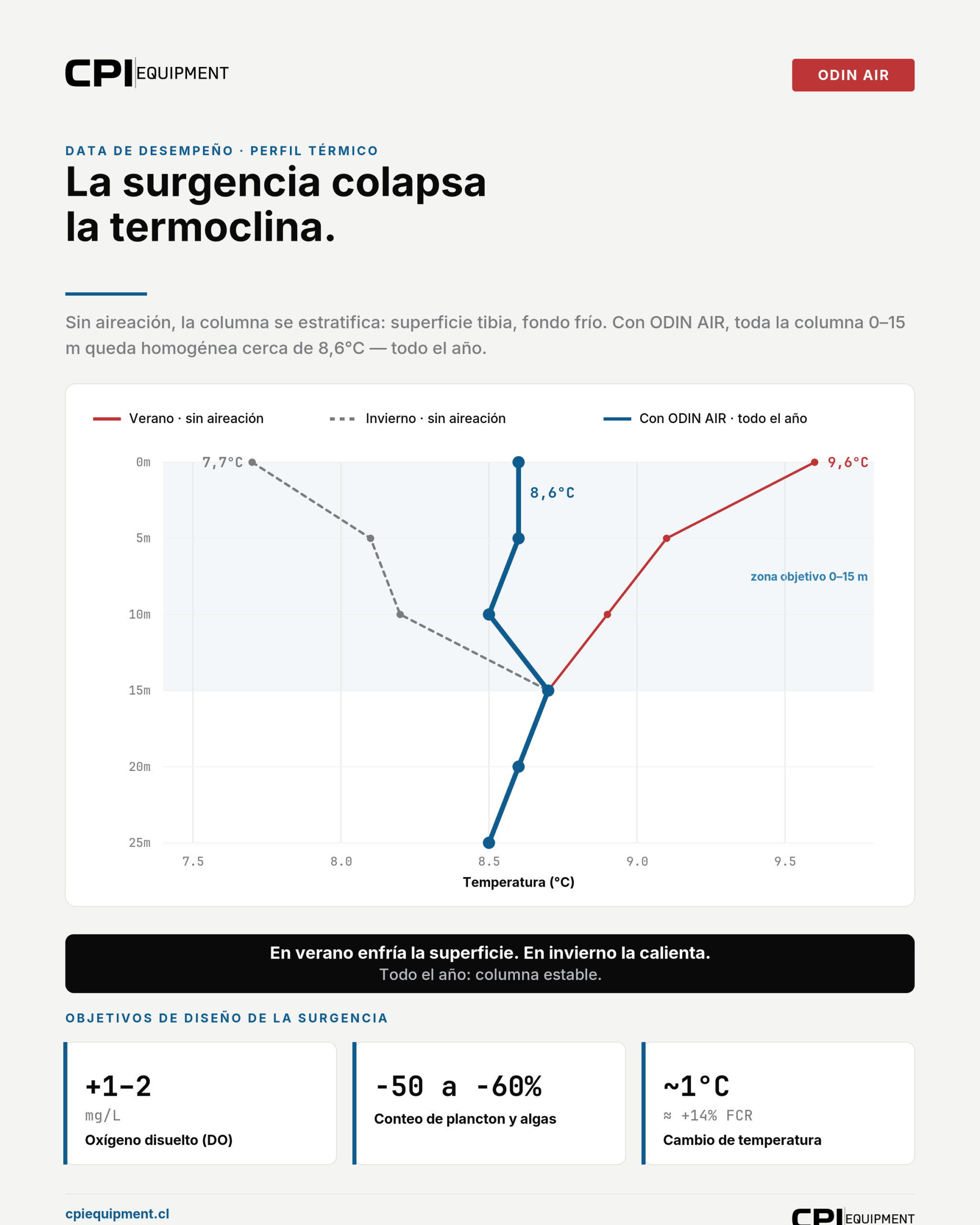
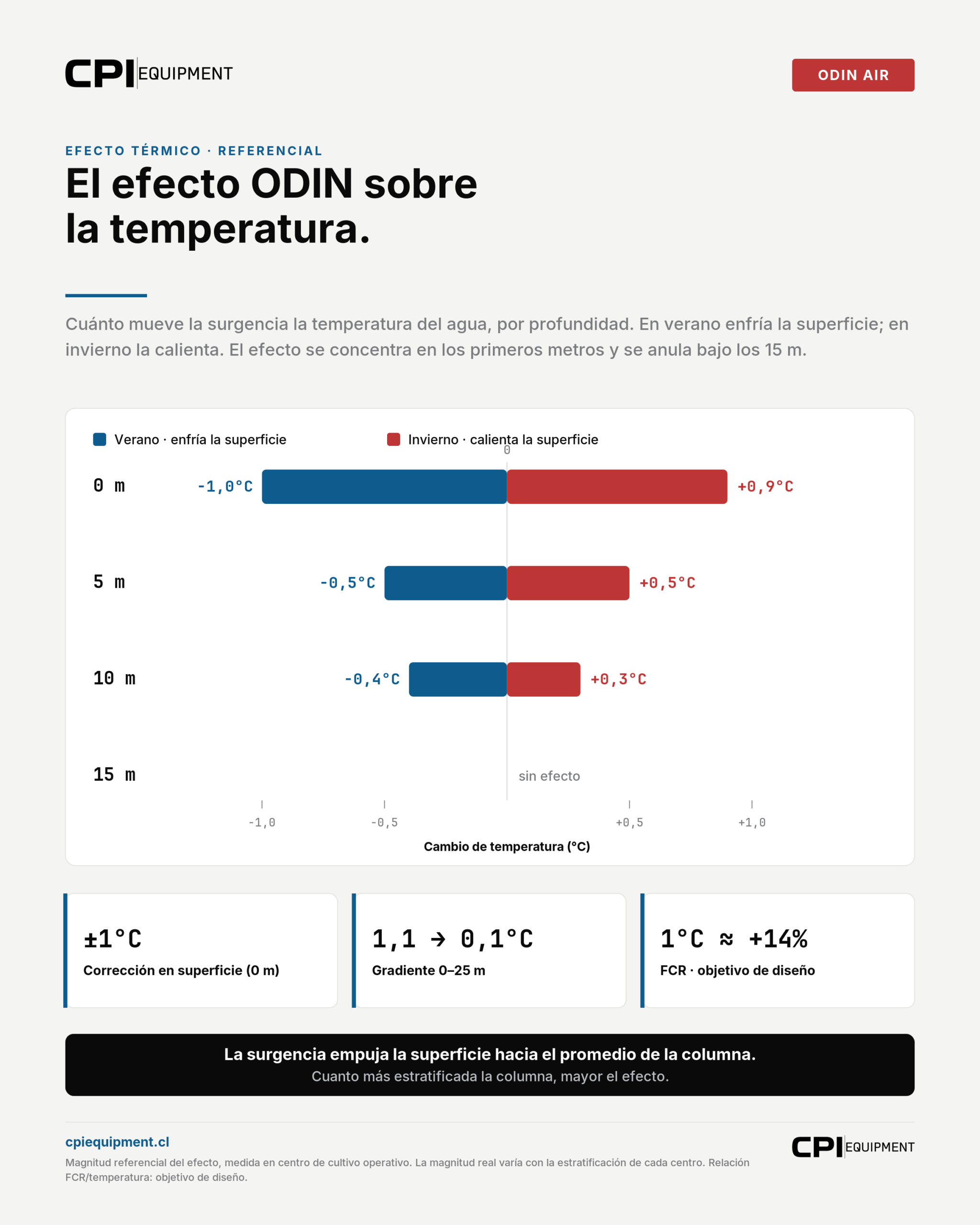
Upwelling is the directed movement of water from deep layers toward the surface. Well-controlled, it evens out temperature, raises oxygen from the bottom, and disperses surface blooms. Under stratified conditions, the surface and bottom can differ by more than 1°C; with upwelling, the 0–15 m column homogenizes near a stable value, year-round. The size of the effect scales with how stratified the starting column is.
The CPI Approach: Measurable Oxygenation, Not Just Hardware
At CPI, we don’t sell equipment — we lease operational performance. Our ODIN systems integrate proprietary hardware and software under a recurring rental model, with maintenance and support included.
- ODIN AIR — smart aeration and controlled upwelling, with individual remote control per diffuser.
- ODIN O₂ — precision oxygenation by real mass, with automatic control.
- Seabed Remediation — sediment oxygenation with nanobubbles.
Let’s Talk About What This Looks Like at Your Site →
Frequently Asked Questions
What’s the optimal dissolved oxygen level for salmon?
Generally, above 5–6 mg/L. Below ~60% saturation you enter hypoxia, with risk of mortality and gill damage.
What’s the difference between aeration and oxygenation?
Aeration moves water and injects air (raising DO passively and stabilizing the column); oxygenation injects metered pure oxygen to correct DO with precision.
Why does oxygen drop at night?
Because without light there’s no photosynthesis producing oxygen, while fish and algae consumption continues. That’s why DO drops in the early morning and during winter.
How is oxygen controlled at a farm site?
With real-time DO sensors and a system that doses by real mass (NL/min).